Zodiac Compatibility: The Real Guide to How Signs Work Together (Beyond Sun Sign Matching)
She sat across from me, birth chart spread out, and said, "But our zodiac love match chart says we're not compatible." Her voice wavered between hope and...
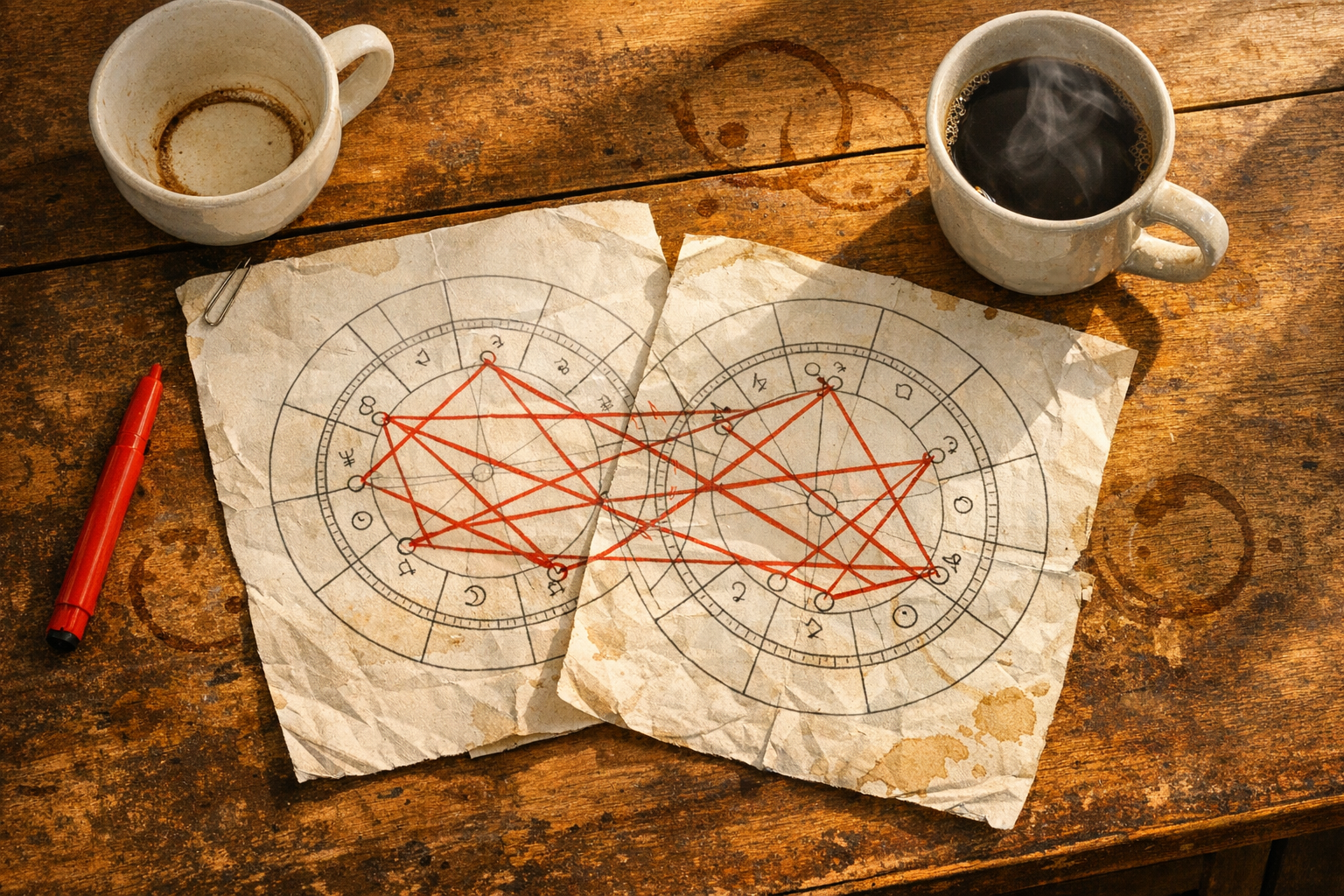
She sat across from me, birth chart spread out, and said, "But our zodiac love match chart says we're not compatible." Her voice wavered between hope and doubt, eyes scanning the glyphs as if searching for a hidden truth. This wasn't the first time I encountered skepticism stemming from those ubiquitous zodiac compatibility charts. They promise simple answers—Gemini with Aquarius, never Scorpio with Leo—but they overlook the rich tapestry of a full synastry reading. The real guide to how signs work together goes far beyond the Sun sign, weaving through Venus, Moon, Mars, and the rulers of your 7th house. It’s in these layers that we discover why ‘incompatible’ signs sometimes forge the strongest bonds.
Dispelling the Sun Sign Myth
Many people enter my practice armed with a basic zodiac compatibility chart, believing it holds the key to their romantic futures. This oversimplification stems from mainstream astrology's fixation on Sun signs alone. While the Sun is a vital part of your chart, focusing solely on it ignores the more nuanced celestial symphony playing in your astrological profile. I’ve seen countless relationships deemed incompatible by these charts thrive because they were rooted in deeper astrological connections.
Consider Michelle, who was perplexed about her supposed incompatibility with her Aries partner based on her Cancer Sun. What those charts failed to show was her Moon in fiery Leo, harmoniously trining her partner's Sun at 12° Aries. This aspect created a mutual understanding that transcended their Sun sign clash. It’s a reminder that astrology compatibility isn't about checking boxes but understanding how your entire chart interacts with another’s.
Additionally, Venus and Mars often play critical roles in relationship dynamics, far more indicative of romantic chemistry than Sun signs alone. Venus represents what we value and seek in relationships, while Mars speaks to our desires and how we pursue them. A Cancer Sun may indeed find warmth in an Aries partner if their Venus at 18° Taurus finds stability with an Aries Mars conjunct their natal Venus. These are the intricate details that reveal the true potential of any romantic pairing.
The Importance of Venus and Mars
Exploring the roles of Venus and Mars in love compatibility can be revelatory for many. Let me recount a session with David, whose Virgo Venus found serenity with his partner’s Pisces Venus, despite their Sun signs clashing—he was a Sagittarian paired with a Gemini. Astrologically speaking, this Venus opposition at 14° created a magnetic pull between them; it was not divisive but rather complementary. This wasn’t merely about differences but about learning and growth within those differences.
Venus in Virgo craves order and routine, yet when placed opposite a Pisces Venus, it learns adaptability and spiritual connection. Their Mars placements further cemented this synergy: David's Mars at 22° Capricorn sextiled his partner's Mars at 20° Scorpio, providing a firm foundation for shared goals and ambitions. It’s these alignments that often make so-called 'incompatible' signs work beautifully in practice.
Such examples underscore why a detailed synastry reading is invaluable. It’s not just about finding common ground but understanding where friction can transform into creativity or where differences encourage personal growth. These are lessons no generic zodiac love match chart can offer.
The Hidden Depth of the Moon
The Moon, often overlooked in simplistic compatibility assessments, governs our emotional world and instinctual responses. In one memorable consultation with Claire, who was puzzled by her profound connection with a Capricorn partner despite her Libra Sun’s apparent mismatch, the mystery unraveled through lunar influence. Her Moon at 8° Pisces trined his Moon at 6° Scorpio—an aspect that provided emotional resonance often mistaken for soul connection.
This lunar harmony created a safe emotional space where both felt understood without needing words. Their Moons facilitated an intuitive communication channel that bridged any solar disagreements or misunderstandings between their Suns or Mercurys. The lesson here is clear: it’s essential to understand the emotional terrain mapped by your Moon sign when assessing relationship potential.
In practice, I've seen countless couples find solace in shared lunar experiences even when other planetary aspects might suggest discord. The Moon’s whisper is subtle yet profound, shaping how we navigate our most intimate connections from a place of depth rather than surface-level assumptions.
The Role of the 7th House
The 7th house in astrology traditionally rules partnerships and marriage, shedding light on what we seek in others and what we offer in return. This aspect of compatibility is often neglected by those relying solely on Sun sign comparisons. For instance, Emily came to me worried about her Virgo partner because her Aries Sun felt constantly on edge around him. However, her natal chart revealed her 7th house cusp in Taurus—signifying stability and reliability as key components she unconsciously sought.
Upon closer examination, Emily's Virgo partner had his Sun at 15° Virgo residing precisely on her Descendant line—a potent indicator that he embodied much of what she needed for balance and completion in relationships. This alignment taught Emily how to appreciate the grounding qualities she initially mistook for dullness or rigidity.
Understanding the nuances of your 7th house can dramatically shift perspectives on compatibility. It's less about rigidly matching signs than recognizing what you need to feel supported and fulfilled within a partnership. As I’ve observed time and again, these revelations can transform perceived mismatches into profound alliances.
The Power of Outer Planets
Outer planets such as Uranus, Neptune, and Pluto often get overlooked in compatibility discussions, yet they wield significant influence in shaping the long-term dynamics of a relationship. Take the case of Steven and Lisa, whose initial meeting under a Saturn transit seemed to predestine struggle. However, Pluto at 24° Scorpio sextile Lisa's Sun ignited a transformative journey for both. It wasn't an easy road, but their shared experiences led to profound personal growth, ultimately forging a bond stronger than any Sun sign alignment could predict. The outer planets remind us that lasting relationships often emerge from shared transformations.
In another instance, I worked with a couple where Neptune was the key player—Michael's Neptune at 15° Sagittarius square his partner's Venus in Virgo created an initial haze of confusion and idealization. This aspect required them to navigate illusions and unmet expectations, fostering a deeper understanding of each other’s inner worlds. Once they embraced this Neptunian challenge, their relationship blossomed into one marked by compassion and empathy. Such planetary alignments illuminate the path where mutual understanding transcends superficial disagreements.
Jupiter, the planet of expansion and optimism, can also play a critical role in compatibility. I recall Natasha and her partner whose charts revealed a Jupiter conjunction at 17° Cancer. This aspect fostered a sense of joy and shared beliefs that enhanced their union. Their zodiac love match wasn’t just about attraction but about creating a life vision together. Understanding how these outer planet influences can nurture expansive growth or invite necessary challenges is crucial for appreciating relationship potential beyond the Sun sign.
Pitfalls in Zodiac Compatibility Charts
A common misconception is that astrology compatibility charts provide definitive answers. However, such charts often oversimplify intricate astrological dynamics into binary outcomes of "compatible" or "incompatible." This can lead individuals to prematurely dismiss or pursue relationships based solely on misleading surface-level data. I've witnessed clients heavily rely on these charts only to overlook more meaningful connections revealed through comprehensive synastry readings. An ethical approach involves recognizing the limits of basic compatibility tools and exploring deeper chart interactions.
The ethical nuance extends to understanding that not all challenging aspects are signs of doom. While hard aspects like squares or oppositions between Mars or Saturn might suggest tension, they also offer opportunities for growth and resilience. Couples who learn to navigate these challenges often emerge with stronger bonds, having overcome what seemed insurmountable obstacles. Simplifying sign compatibility into positive or negative categories ignores the potential for evolution within relationships.
Practical Steps for Deeper Compatibility Insights
To truly understand zodiac compatibility beyond superficial charts, start by examining your Venus and Mars placements in detail. Consider how their aspects interact with your partner’s chart—do they form supportive trines or challenging squares? Reflect on how these aspects manifest in your relationship dynamics, providing both comfort and motivation to grow. A deeper dive into these planets will reveal where romantic chemistry lies and where effort is needed to create harmony.
Next, explore the synastry between your Moon signs to uncover how emotional connections influence your partnership. Observe how shared lunar energies create bonds that go beyond verbal communication, often serving as a foundation for mutual understanding. Consider journaling your emotional experiences within the relationship to identify patterns aligned with lunar movements or aspects, gaining insights into how you emotionally engage with each other.
Lastly, take time to understand your 7th house dynamics fully. This involves not just looking at the sign on the cusp but also any planets residing there and their aspects. Consider how these elements reflect your unconscious needs in partnerships and what you offer in return. By recognizing this personal landscape, you can cultivate more fulfilling relationships built on authentic compatibility rather than presumptions based solely on Sun signs.
Astrology compatibility is an art requiring attention to the entire celestial tapestry that defines our connections. If you're curious about delving into the nuances of zodiac love matches and uncovering hidden potentials in your relationships, Shymea's Synergy feature offers detailed insights by examining real planetary contacts between two charts. Such tools can illuminate paths you may not have considered otherwise, providing an invaluable resource for deepening your understanding of relational dynamics.
Compare your chart with someone else's using Shymea's Synergy.
Try Shymea Free