Tropical vs. Sidereal Astrology: Which System Should You Follow
She sat across from me, her birth chart spread out on the table, eyes scanning it like a map to some forgotten treasure. "I don't get it," she said, confusion...
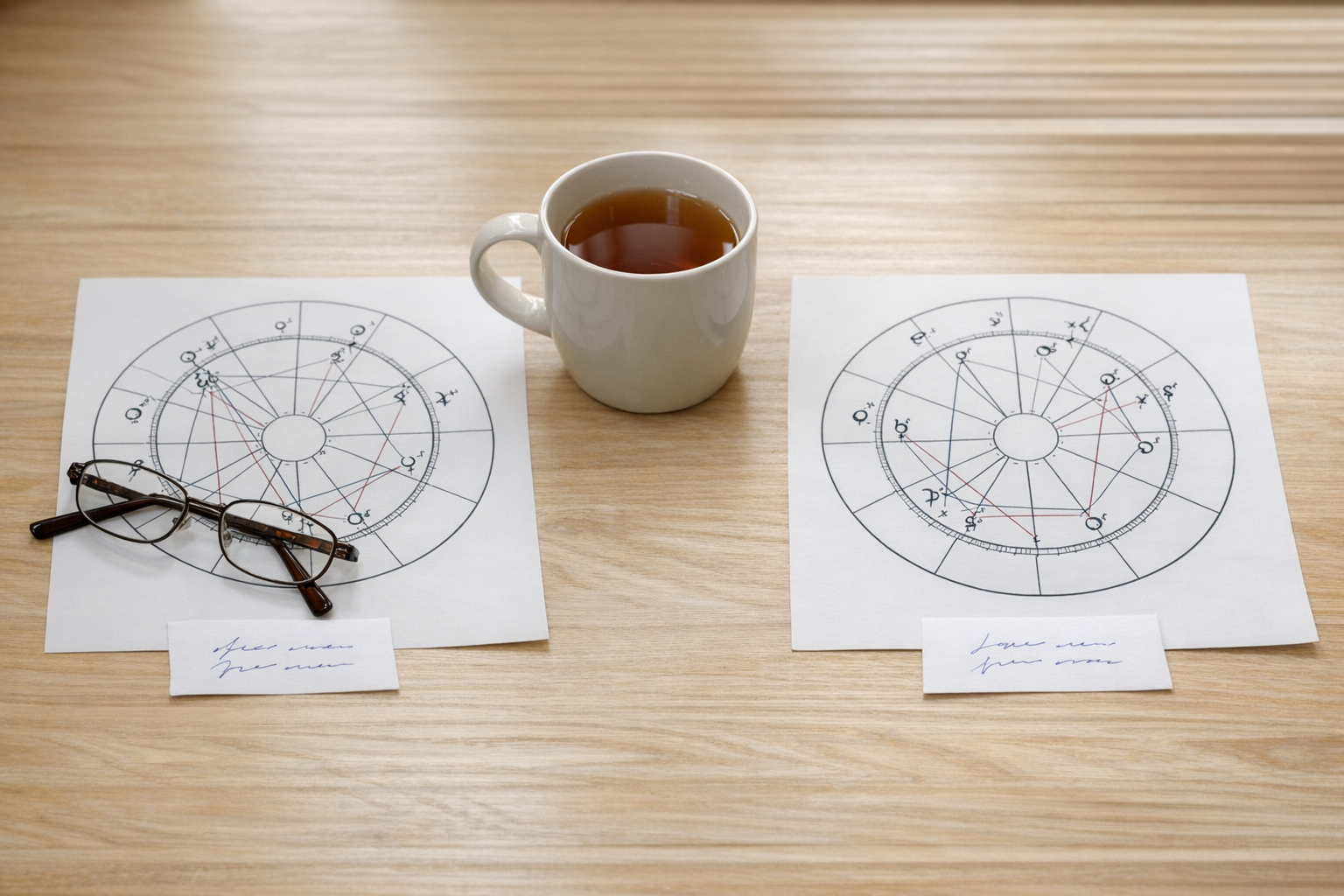
She sat across from me, her birth chart spread out on the table, eyes scanning it like a map to some forgotten treasure. "I don't get it," she said, confusion deepening the lines on her forehead. "I thought I was a Leo, but now I'm reading that I'm actually a Cancer because of this sidereal astrology thing?" Her voice carried the weight of disappointment, as if a cornerstone of her identity had suddenly been questioned. This wasn't the first time I'd heard this. In my 15 years as an astrologer, the tropical vs. sidereal debate has challenged many clients who wonder if they've been living under a false zodiac sign all along. Let's unravel this cosmic conundrum together.
Understanding Precession: The Root of Zodiac Confusion
Most people are blissfully unaware of the astronomical phenomenon called precession and how it plays into the tropical vs. sidereal astrology debate. Precession is the gradual wobble in Earth's rotation axis, and over millennia, it causes the backdrop of stars to shift ever so slightly in our sky. This shift means that the constellations are no longer in the same place as they were thousands of years ago when Western astrology was first codified. Clients often come in panicked after reading that their "real" sign should be different due to this drift—a misunderstanding fueled by the persistent myth of Ophiuchus, the so-called 13th zodiac sign.
In my practice, I've encountered clients like Jonathan, whose 22° Aries Sun in tropical astrology appears to fall at 28° Pisces in the sidereal zodiac. Jonathan panicked initially, wondering if his entire self-concept was based on a lie. Yet, the truth is more nuanced. Tropical astrology, which is season-based, aligns Aries with the Spring Equinox—an archetype of initiation and new beginnings that's energetically valid regardless of star constellations. Sidereal astrology, or Vedic astrology as it's also known, uses fixed star positions to determine signs. Both systems work within their own frameworks and speak to different elements of human experience.
The ophiuchus myth further muddies the waters, often causing unnecessary existential crises. Introduced into popular culture as a dramatic "new sign," Ophiuchus isn't part of either mainstream zodiac system for good reason. The 12-sign zodiac each represents distinct archetypes and energy dynamics that have held their ground for centuries. It's crucial to understand that these systems don't become obsolete simply because someone introduces an extra character into the play.
Tropical Astrology: Seasons and Symbology
The tropical zodiac begins with Aries at 0°, coinciding with the Vernal Equinox—a point of balance between light and dark—and not with a constellation's actual placement in the sky today. This system speaks to cyclical patterns related to Earth's seasons. Take my client Maria, who finds deep resonance with her 15° Libra Moon in her 4th house in tropical astrology. Here, Libra's association with balance and harmony manifests in Maria's desire for a peaceful home life—an interpretation equally valid even if sidereally her Moon falls in Virgo.
Another client, DeAndre, embodies his 10° Capricorn Ascendant perfectly within this seasonal framework. His life purpose is expressed through traditional Capricorn values: ambition and structure manifesting clearly in his career trajectory within corporate law—a path chosen not because of sidereal placements but because tropical Capricorn speaks to his inherent drive for accomplishment.
Tropical astrology's alignment with equinoxes and solstices is not arbitrary; it's a language developed over centuries to articulate human experiences as they ebb and flow through life's seasons. This system doesn't deny sidereal's celestial precision; rather, it complements it by offering another lens through which we can examine our lives.
Sidereal Astrology: Starry Precision
Sidereal astrology remains anchored to the constellations as they appear today, creating a system often considered more 'astronomically accurate.' For many clients exploring their charts through a sidereal lens for the first time, like Jenna, there's an initial shock followed by intrigue. Jenna's tropical Sagittarius Sun at 3° shifts to Scorpio at 29° sidereally—a change she found illuminating once she embraced Scorpio's depth and transformative potential alongside Sagittarius' expansive worldview.
In sidereal terms, houses and aspects can take on different energies due to these shifts. Take Rajiv, whose natal chart holds Mars at 18° Leo in the 6th house tropically but at 24° Cancer sidereally. This adjustment redirected Rajiv's understanding from leadership-driven work initiatives (Leo) toward nurturing team dynamics (Cancer). With guidance, he found harmony between both interpretations.
My work often involves helping clients reconcile these differences not as contradictions but as complementary insights. The sidereal system can highlight different facets of a person's potential that tropical astrology might touch less visibly—a revelation that sometimes brings profound personal insights into play.
The Debate's Real-World Implications
What fascinates me about this ongoing debate is how deeply personal it becomes for my clients once they're confronted with differing astrological maps of themselves. While each system offers its own wisdom, neither seeks to invalidate the other; they simply provide unique methodologies for understanding one's path and purpose.
The real-world implications often lie not in which system is 'correct' but how individuals use these cosmic tools to navigate life. For some clients like Amanda, whose Venus sits at 5° Taurus tropically but shifts to Aries sidereally, this isn't about replacing one self-concept with another but integrating both perspectives to enrich her understanding of love and values.
Embracing Duality: A Case for Both Systems
Consider the story of Ethan, a long-time client who initially clung tightly to his 14° Gemini Sun as described in tropical astrology. When he discovered that his sidereal Sun sat at 20° Taurus, he experienced a crisis of identity. However, as we worked through these seemingly disparate energies, something beautiful emerged. Ethan realized that his Gemini Sun's curiosity complemented Taurus's grounded perseverance. Professionally, this duality allowed him to balance rapid information processing with practical application, enhancing his work as a software developer who needed both vision and stability.
There’s also Hannah, whose sidereal Moon at 25° Capricorn seemed to conflict with her tropical Aquarius Moon ideals of innovation and change. But when approached holistically, Hannah discovered how her emotional resilience (Capricorn) supported her humanitarian pursuits (Aquarius). Rather than seeing these as discordant notes in a song, she began to view them as harmonious chords in a larger symphony, enabling her to lead social initiatives with both structure and ingenuity.
These stories illustrate that both systems can coexist within a person's life narrative. The tropical vs sidereal debate need not be divisive; instead, it offers a broader palette from which to draw insights. Each system highlights different layers of one's psyche and potential, much like how different lenses can bring separate aspects of the same scene into focus. This broader understanding can lead to more nuanced self-perception and personal growth.
Common Misconceptions: It's Not About Choosing Sides
One common misconception is the belief that you must choose between tropical and sidereal astrology as if one were inherently superior. This binary mindset can be limiting. Both frameworks originate from rich traditions—Western astrology aligning with seasonal archetypes and Vedic astrology rooted in ancient star-based wisdom. Each system provides a distinct but equally valuable viewpoint on human experience. Insisting on exclusivity denies the holistic approach that astrology encourages us to embrace.
Another pitfall involves seeking external validation in astrology rather than using it as a tool for self-exploration. I've seen clients over-rely on astrological systems to dictate every decision, missing the opportunity for introspection. In my practice, ethical astrology means guiding clients towards using their charts—whether tropical or sidereal—as mirrors for reflection rather than maps with predetermined routes. This mindset empowers individuals to take ownership of their journeys while valuing diverse astrological insights.
Practical Advice: Navigating Your Personal Astrological Landscape
If you're grappling with tropical vs sidereal insights, start by examining your charts side by side. Identify where each system offers resonance or tension in areas like relationships, career, or personal growth. Reflect on how these interpretations speak to your lived experiences. Are there aspects of your personality that have been underexplored? Perhaps sidereal astrology can highlight traits or tendencies that tropical placements might overlook.
Consider integrating insights from both systems into your daily life by aligning actions with planetary energies from each chart. When Sarah found her sidereal Mars at 12° Virgo in conflict with her tropical Mars at 14° Libra, she used both interpretations creatively—channeling Virgo's precision in planning her artistic projects while embracing Libra's aesthetic vision during execution. Such integration allows for richer self-expression and personal development.
Also, engage with professional astrologers who understand both systems deeply for guidance. They can offer nuanced interpretations that consider the full spectrum of your chart's potential rather than focusing solely on one framework. A seasoned astrologer can help you synthesize these layers into actionable insights tailored to your unique life path.
Astrology is not about finding one 'correct' system but embracing the wisdom each offers us on our journey. If you're curious about exploring both tropical and sidereal dimensions of your natal chart, Shymea's Birth Chart feature provides comprehensive readings that honor both perspectives, allowing you to delve deeper into the multifaceted nature of your cosmic blueprint.Discover these dynamics in your own chart with Shymea's Birth Chart feature.
Try Shymea Free