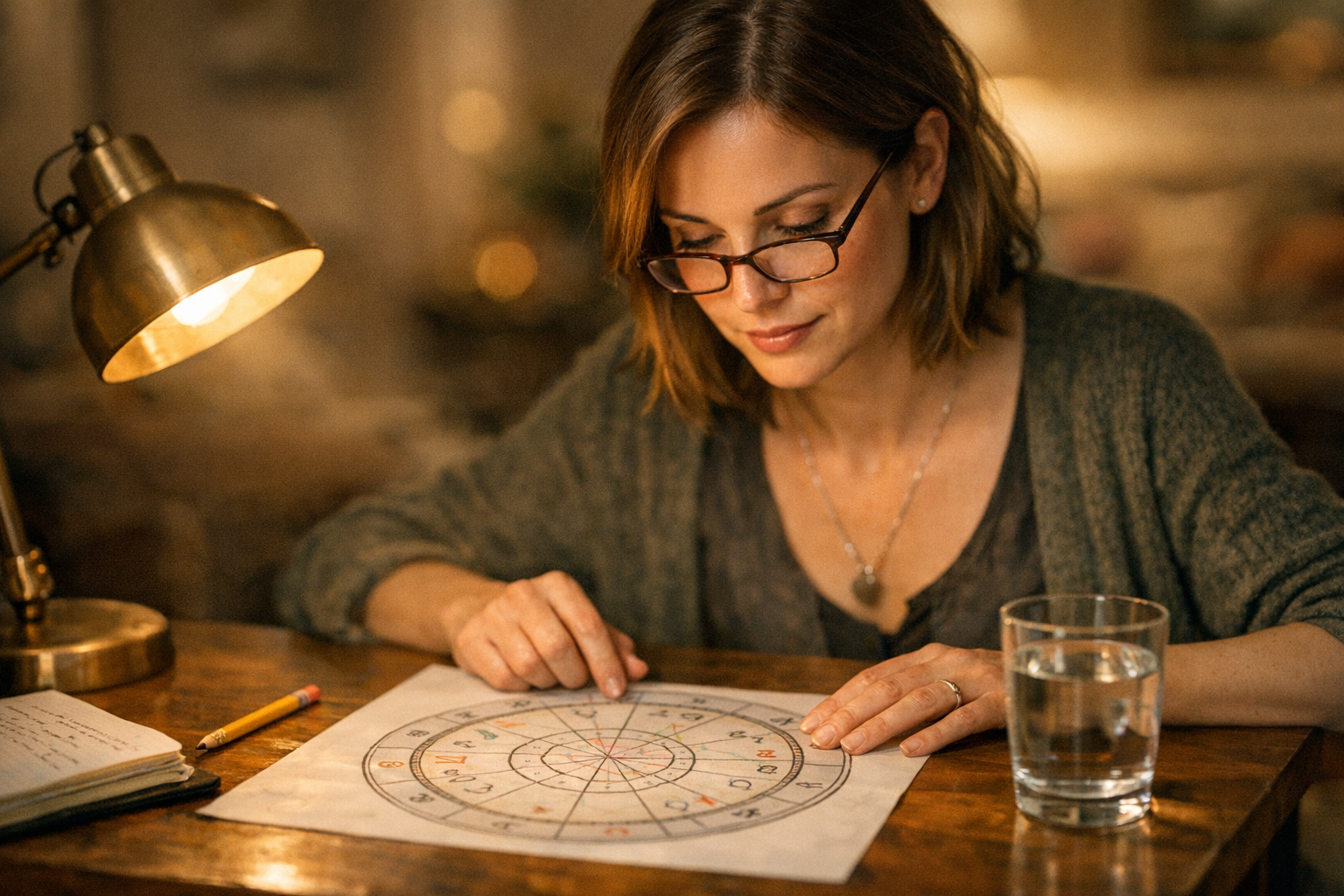
Free Birth Chart Calculator: How to Generate and Actually Understand Your Natal Chart
Most people think that generating a free birth chart is the hard part, but I've seen countless clients who've managed to do just that, only to find themselves...
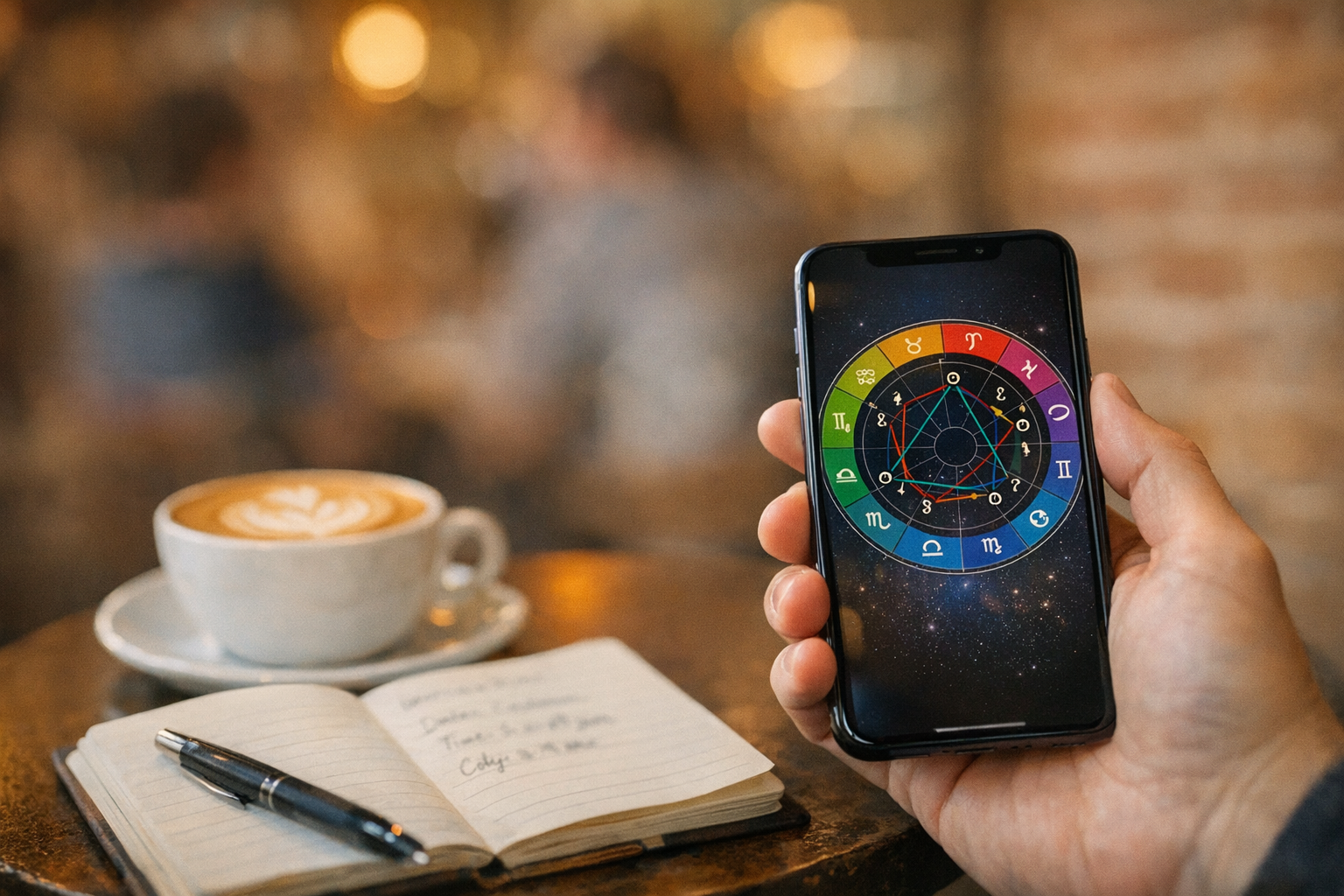
Most people think that generating a free birth chart is the hard part, but I've seen countless clients who've managed to do just that, only to find themselves staring at a baffling wheel of symbols and lines. The truth is, anyone can use a natal chart calculator—it's understanding what it actually means that's the real challenge. Imagine finally pinpointing your Sun at 15° Taurus in the 6th house, only to discover that everything from the Moon's phase to your Ascendant is telling a different story. It's this rich tapestry of information that makes astrology so profound and, initially, so perplexing. But don’t worry—deciphering your chart can be an enlightening journey if you know how to read the map.
Why Your Data Matters
The first step in using any natal chart calculator effectively is gathering accurate data: your birth date, time, and location. While many assume that a rough estimate will suffice, astrology hinges on precision. Your birth date sets the stage for planetary positions, but it’s your birth time that fine-tunes these placements to specific degrees and houses. For instance, if you're born on April 25th, 1990, at 3:00 PM, you might find your Sun at 5° Taurus in the 8th house. A slight error here could place it in another house entirely, altering interpretations drastically.
The importance of birth time cannot be overstated. I've seen numerous charts where a mere 15-minute difference shifts the Ascendant by several degrees or even signs, changing not only the Rising sign but also the house cusps. If you can't find the exact time on your birth certificate, try reaching out to the hospital or county records office. In rare cases where this isn't feasible, a seasoned astrologer can help rectify your chart through life event timing.
Then there’s birthplace. Latitude and longitude determine how the sky looks from your perspective on Earth. Confusing cities with similar names or not accounting for timezone differences can lead to errors that cascade through your entire chart. Remember, details matter: specifying 'Springfield' without clarifying whether it's in Illinois or Massachusetts could skew the data significantly.
Dissecting Your Chart: Planets and Their Placements
Once you've entered all your data into a free natal chart calculator, you'll see a circular diagram known as a horoscope wheel. This is where many people get lost, but breaking it down makes it manageable. Start with your personal planets: Sun, Moon, Mercury, Venus, and Mars. Their placements by sign and house are foundational in understanding your personality and motivations.
Consider our hypothetical individual born on April 25th, 1990 at 3:00 PM in Springfield, Illinois. They might have Mercury at 12° Aries in the 7th house—a placement suggesting direct communication style within partnerships. Meanwhile, Venus at 22° Pisces in the 5th house highlights a romantic idealism expressed through creativity.
Next, look at outer planets—Jupiter through Pluto—which shape generational themes but still personalize based on their house positions. For instance, Jupiter at 10° Cancer in the 11th house could indicate expansive social networks and opportunities for growth through friendships or group affiliations. Understanding these subtleties transforms random symbols into insights about career directions or even social standing.
The Power of Aspects: Connecting the Dots
Another layer in interpreting your natal chart involves aspects—angular relationships between planets that describe dynamics within your psyche. In my years of practice, I've seen how a single tight aspect can underpin life themes or struggles more than any standalone placement.
Let’s return to our example: this individual might have their Mars at 8° Aquarius forming a square with Pluto at 9° Scorpio in the 4th house. This tension might manifest as intense internal conflicts around self-assertion versus deeply rooted fears or family conditioning. When such an aspect appears in a chart, it often points to transformative experiences that demand growth.
A client once came to me confused about persistent frustrations in his career despite seemingly favorable planetary placements. His Sun was well-positioned in Taurus but squared by Uranus from his 10th house of career, indicating sudden upheavals and unexpected changes he hadn't accounted for until we unlocked his chart's full potential.
Making Practical Use of Your Chart
Decoding your natal chart's intricacies isn't just an intellectual exercise—it has tangible applications in everyday life. Understanding personal strengths and challenges can guide decisions from choosing career paths to navigating relationships effectively.
Take our hypothetical person with their Moon at 18° Libra conjunct the Midheaven—public persona—suggesting an emotional investment in how they’re perceived professionally. Recognizing this influence helps them prioritize work-life balance without sacrificing authenticity.
Incorporating astrological insights into personal development plans can foster self-awareness and improve interpersonal dynamics. For instance, knowing you have Venus trine Neptune might inspire exploring creative outlets like art or music as means of emotional expression.
Embracing the Complexity: Beyond the Basics
Understanding the complex interplay of elements in a natal chart often requires a shift in perspective. For example, I've worked with a client whose Mercury was in Gemini, square to Neptune in Pisces. Despite having a sharp intellect, she struggled with clarity and often felt misunderstood. This aspect suggested that her communication style might blur boundaries between reality and imagination, leading to misinterpretations. Once she recognized this dynamic, she began to consciously clarify her thoughts before speaking, mitigating confusion in both personal and professional interactions.
It's also crucial to observe how planets behave in different houses. A client with Mars in the 12th house of hidden realms found her energy felt trapped, manifesting as frustration and restlessness. However, channeling this energy into meditative practices or working behind the scenes on creative projects unlocked a reservoir of productivity and peace. By understanding her chart’s intricacies, she transformed a perceived weakness into a powerful asset.
The nodes of the Moon—North and South—provide yet another layer of guidance, indicating past life tendencies and current life purpose. A client with her South Node in Leo and North Node in Aquarius discovered that while her natural inclination was toward seeking attention and validation (Leo), growth lay in embracing community-oriented goals and innovative thinking (Aquarius). By shifting focus from personal accolades to collective progress, she aligned more closely with her life’s potential.
Navigating Misconceptions: The Astrological Maze
Misconceptions abound in astrology, particularly regarding 'bad' aspects or signs. Clients often fear squares or oppositions, assuming they spell doom. Yet, these tensions can be transformative forces. In my practice, I've observed many individuals with Sun square Saturn who initially struggle with self-doubt but ultimately develop resilience and discipline through life's challenges. Recognizing such dynamics as growth opportunities rather than obstacles can shift how you engage with your chart.
Another common pitfall is over-reliance on sun sign horoscopes or reductive interpretations. I've seen clients who dismissed astrology because they felt their sun sign descriptions were too generic or inaccurate. This surface-level understanding misses the depth and nuance a full natal chart offers. Real insight comes from synthesizing various factors—signs, houses, aspects—into a cohesive narrative that reflects your unique journey.
Ethically, it's vital not to use astrology as an excuse for behavior or a deterministic tool that denies free will. While charts offer profound insights into tendencies and potential paths, they don't dictate destiny. I've counseled clients who felt trapped by 'difficult' charts, helping them see how conscious choices can transcend astrological predispositions.
Applying Your Chart to Everyday Life
Your birth chart isn’t just a snapshot of celestial positions—it’s a guide to self-awareness and personal development. Start by reflecting on any recurring themes or challenges in your life and exploring how they align with your chart’s aspects. A client of mine with Venus square Saturn initially experienced difficulties in relationships, often feeling unworthy of love. However, recognizing this pattern allowed her to work on self-esteem issues and establish healthier boundaries.
Astrology can also support career decisions by identifying strengths and motivations. If you have Mars in Capricorn trine your Midheaven, ambition paired with strategic planning could be key to professional success. Similarly, someone with Jupiter in Sagittarius in the 9th house might find fulfillment through travel or higher education pursuits. Understanding these placements can guide you toward roles that align with your inherent qualities.
Incorporate astrological insights into daily routines by aligning activities with planetary transits or moon phases. For instance, use Mercury retrograde periods for reflection rather than initiating new projects. Being aware of these cycles fosters adaptability and resilience amidst life's ebbs and flows.
Your birth chart is more than just lines and symbols—it's a map to understanding yourself more deeply. With Shymea's Birth Chart feature, you're offered an insightful exploration of every planet, house, and aspect tailored to your unique birth data. If you're curious about unlocking the nuanced layers of your personality, Shymea is here to guide you on your astrological journey.
Discover these dynamics in your own chart with Shymea's Birth Chart feature.
Try Shymea Free