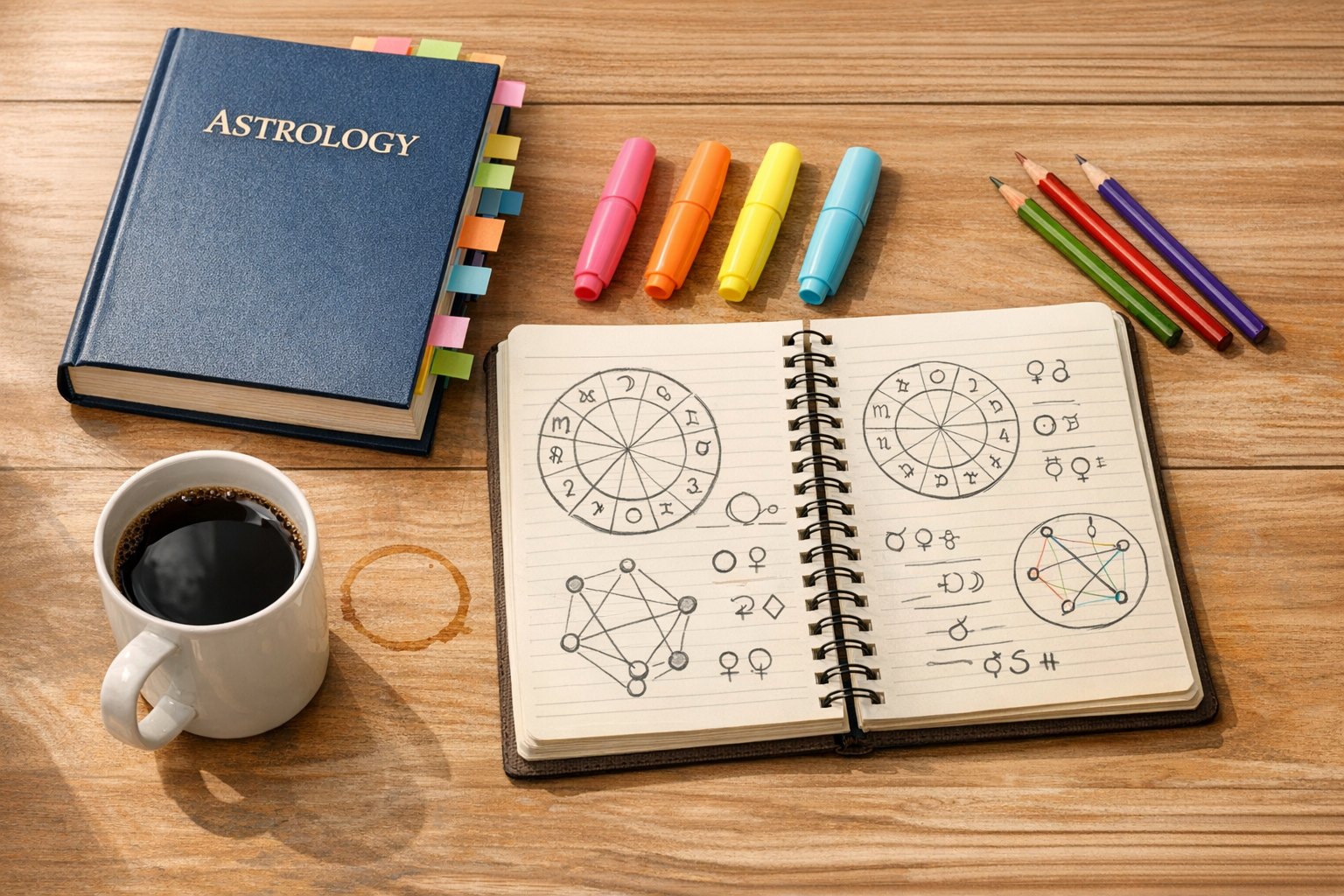
Astrology Glossary: 50 Essential Terms Every Beginner Needs to Know
You're staring at your astrological chart, feeling a bit like an explorer who’s just landed on a foreign planet. Planets are scattered across houses, strange...

You're staring at your astrological chart, feeling a bit like an explorer who’s just landed on a foreign planet. Planets are scattered across houses, strange symbols hint at mysterious meanings, and you're left wondering where to start. Whether you’re trying to decode your Sun-Moon-Rising trio or understand why Saturn seems to be the cosmic taskmaster in your life, understanding astrology terms is crucial. Astrology is a language, after all, and like any language, it comes with its own vocabulary. In this glossary, you’ll find the key terms that will unlock the doors to deeper self-awareness and cosmic insight, transforming confusion into clarity.
Chart Basics
Many newcomers to astrology look at their natal chart and feel overwhelmed by the myriad of symbols and lines. But getting a grip on chart basics can turn this chaos into coherence. At the heart of astrology is the Ascendant or Rising Sign. This is the sign that was rising on the eastern horizon at your birth, setting the stage for how you present yourself to the world. It’s not just about first impressions; it’s about how you step into any new situation. If your Ascendant is in Capricorn, for instance, people might see you as disciplined or reserved at first glance.
Next, consider the Midheaven, or MC, which represents your public persona and career aspirations. Located at the cusp of the 10th house, it's like the peak of your personal mountain. If your Midheaven is in Cancer, nurturing professions or roles that involve care might be most fulfilling for you. To get a better sense of this, locate your MC’s degree and check which planets aspect it—they’ll shape your professional journey.
The Houses are another fundamental concept in astrology. Each house governs different areas of life—from personal resources (2nd house) to partnerships (7th house) to aspirations (11th house). The signs on these house cusps color how these life areas manifest for you. For instance, if Taurus rules your 5th house of creativity and romance, you might find stability and pleasure in artistic pursuits or prefer long-term romantic commitments.
Aspect Terms
Aspects describe the angles planets form with each other in your chart, each bringing its own flavor of energy. A Conjunction, where two planets sit together within a few degrees, merges their energies intensely. For example, if you have Venus at 15° Aries conjunct Mars at 17° Aries in your 7th house, relationships could be fiery and passionate—sometimes overly so! Look at your own chart now and find any conjunctions; consider how those planetary energies interplay in that specific house.
A Square, usually a 90-degree angle, introduces tension but also opportunity for growth. Suppose Mercury at 10° Scorpio squares Uranus at 12° Aquarius in your chart; this could suggest a mind that's innovative but often restless or rebellious. Recognizing these squares allows you to consciously harness their challenges into productive change.
The Trine aspect offers ease and flow between planets typically 120 degrees apart. With Jupiter at 22° Leo trine Neptune at 24° Sagittarius in the 9th house, you might find spiritual or philosophical exploration comes naturally to you. Check for trines in your chart—they're areas where life feels more harmonious and expansive.
Planetary Terms
Each planet plays a specific role in your chart, acting like characters in your life's play. The Sun symbolizes core identity and life force—your ego's backbone. If the Sun is positioned at 5° Gemini in the 3rd house, communication and adaptability become central themes in expressing who you are. It’s helpful to track transits that aspect your natal Sun as these will affect how you perceive yourself over time.
The Moon governs emotions and instincts; it’s where comfort resides within us. I recall a client with Moon in Pisces at 18° in her 4th house; she found solace near water and felt deeply connected to her ancestors' roots. Understanding your Moon sign can reveal how best to nurture yourself emotionally.
Mars signifies drive and action—it’s your inner warrior. When Mars sits at 29° Virgo in your 11th house of friendships, as another client experienced, there can be a meticulous approach to social networks and group goals. How does Mars influence your action style? Look for aspects it makes with other planets for clues.
Timing Terms
Tuning into astrological timing can illuminate when certain energies are most potent in our lives. Transits are current planetary movements impacting our natal charts momentarily but significantly. If transiting Pluto is squaring your natal Venus, expect transformations around relationships or values; nothing remains superficial under Pluto's gaze.
The Progressed Moon reveals emotional evolution over time—changing signs approximately every two-and-a-half years offering insights into personal growth phases. I once had a client whose progressed Moon moved into Capricorn right before she began an intensive career path focusing on discipline and achievement—her emotional landscape shifted accordingly.
Saturn Returns, occurring approximately every 29 years when Saturn completes its orbit back to its natal position, signify times of reckoning with maturity and responsibility—a period often feared yet deeply transformative when navigated with awareness.
Stay tuned for Part Two where we'll continue exploring more essential terms that will deepen your understanding of astrology's rich vocabulary.
In the meantime, consult Shymea's Birth Chart feature to explore how these concepts play out uniquely for you.
Section 5: Understanding Retrogrades
Retrogrades are a staple in astrological vocabulary, often misunderstood and feared. Planets appear to move backward in the sky, symbolizing a time for introspection and reevaluation. Take Mercury retrograde—it's notorious for communication mishaps and travel delays. In practice, however, it's a period to rethink and reorganize. One client found that during Mercury retrograde, revisiting old drafts led to a significant publishing breakthrough. It's an opportunity to slow down and process rather than push forward without reflection.
Venus retrograde invites us to reconsider matters of love, aesthetics, and self-worth. If Venus retrogrades in your 12th house, as I observed with a client, the focus might shift inward, prompting deep reflection on past relationships and unresolved emotional patterns. This can lead to profound insights, clearing the way for healthier connections once Venus resumes direct motion.
Mars retrograde challenges us to reassess how we assert ourselves and pursue desires. A client with Mars retrograde transiting their 7th house of partnerships experienced this as a period where direct confrontation in relationships turned into more strategic and patient dialogues. Such retrogrades aren't roadblocks; they're recalibration periods that can lead to lasting growth if met with awareness.
Section 6: Misconceptions About Astrology
A common misconception in astrology is that it predicts fixed destinies, but it's more about potentials and tendencies. I often encounter clients who expect astrology to tell them exactly what will happen next, but that's not its purpose. Astrology serves as a guide, offering insights into potential paths and energies you can work with. It provides the language to articulate what's unfolding internally and externally, but free will always plays a role.
Another pitfall is the fatalistic interpretation of challenging aspects like squares or oppositions as inherently negative. In reality, these tensions drive us toward growth and greater self-awareness. A client with a T-square involving Sun, Moon, and Saturn initially felt overwhelmed by constant internal conflict but eventually learned to harness this energy for discipline and personal development. Challenging aspects demand effort but offer substantial rewards when engaged constructively.
Section 7: Practical Applications of Astrology
Astrology becomes truly powerful when you integrate it into your daily life. Start by observing the moon phases in relation to your natal chart. New Moons offer fresh starts; Full Moons bring culminations. By syncing intentions with these natural cycles, you align your personal goals with cosmic rhythms. A client focused on career goals found setting new intentions at New Moons in her 10th house brought clarity and momentum.
Tracking daily transits can be equally illuminating. For instance, if transiting Jupiter is forming a trine with your natal Sun, seize that time for expansion in the area of life ruled by the Sun's house position. This is when opportunities flow more easily. A client used such a Jupiter-Sun trine to successfully launch a creative project she’d been planning.
Your birth chart is your personal cosmic blueprint—knowing it intimately allows you to navigate life with greater self-awareness. Consider journaling about significant transit experiences or retrograde periods; over time, you'll recognize patterns unique to your chart that can inform future decisions and strategies.
Astrology's nuanced language reveals dimensions of our experiences that might otherwise remain hidden. If you're curious about how these astrology terms apply specifically to you, Shymea's Birth Chart feature offers personalized insights into your unique chart dynamics, helping you explore these concepts in depth.
Explore everything Shymea offers — your birth chart, daily transits, compatibility, and more.
Try Shymea Free